It was inevitable that Pugsley was going to need a new pair of
shoes. To this point, the current offerings of high-volume,
large-footprint bicycle rubber has consisted of downhill specific,
or homemade, or scarce out-of-production tires
designed for specific out-of-production rims. Though
downhill tires are readily available, they are heavier
than we need. We ultimately desire a tire that fits
the following criteria: 1) The ability to crawl over
and through a wide array of soft and loose surfaces
and materials without packing up. 2) A size that
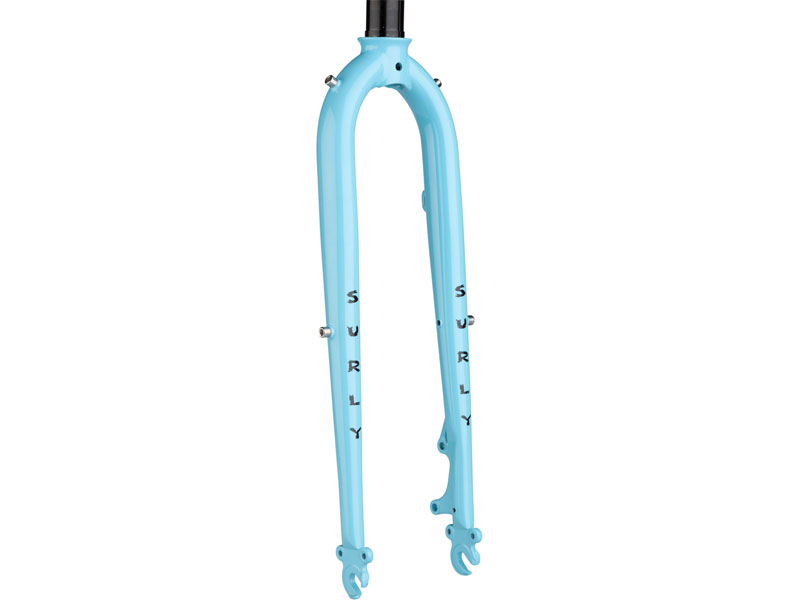
will fit within the confines of the Pugsley frame
and fork. 3) A weight less than 26 x 3.0" downhill tires. 4) Full compatibility with 26"
Large Marge rims and other wide bicycle
specific rims. Our only option was to design
our own tire.
The Endomorph 3.7 is the product of our effort.
It’s 94mm wide (3.7") x 740mm tall (29") on
our rims. It’s the highest-volume production
bicycle tire on the market at this point. And,
at 1260 grams, our 60 tpi tire weighs 300–400
grams less than lower-volume 3"-wide DH tires.
Most 3" DH tires hover around 1600 grams.
The center portion of the Endomorph’s medium durometer
(60a) tread is comprised of widely spaced
chevrons made up of small, low-profile
knobs. Higher-profile knobs, at the outer edges of
the tread, provide cornering traction and lateral
stability in the loose stuff. No tread pattern is going
to be perfect in every condition, but the Endomorph’s
tread tends to perform quite well on a variety of
surfaces. Truthfully, the casing volume has as much to do
with our tire’s performance as the tread pattern does. High
volume allows the use of low pressure without much risk of pinch flats. The use of low
pressure allows the tire casing to spread out on the ground, providing greater traction and
floatation due to the increased footprint. We’ve run our tires as low as 5 psi in deep snow,
but 8-10 psi is generally low enough for most snow and sand riding. Want to ride on harder
surfaces? Pump ‘em up to 15 psi, if the surface is hard, but rough….up to 28 psi, if
you’re riding pavement or smooth, hard dirt. Of course, this is just a guideline. Trial and
error/success is the best way to determine what pressure will best compliment your riding
style, trail (or lack thereof) conditions and your weight.
Embrace the fat. Ride more. Walk less.
Read this!
|