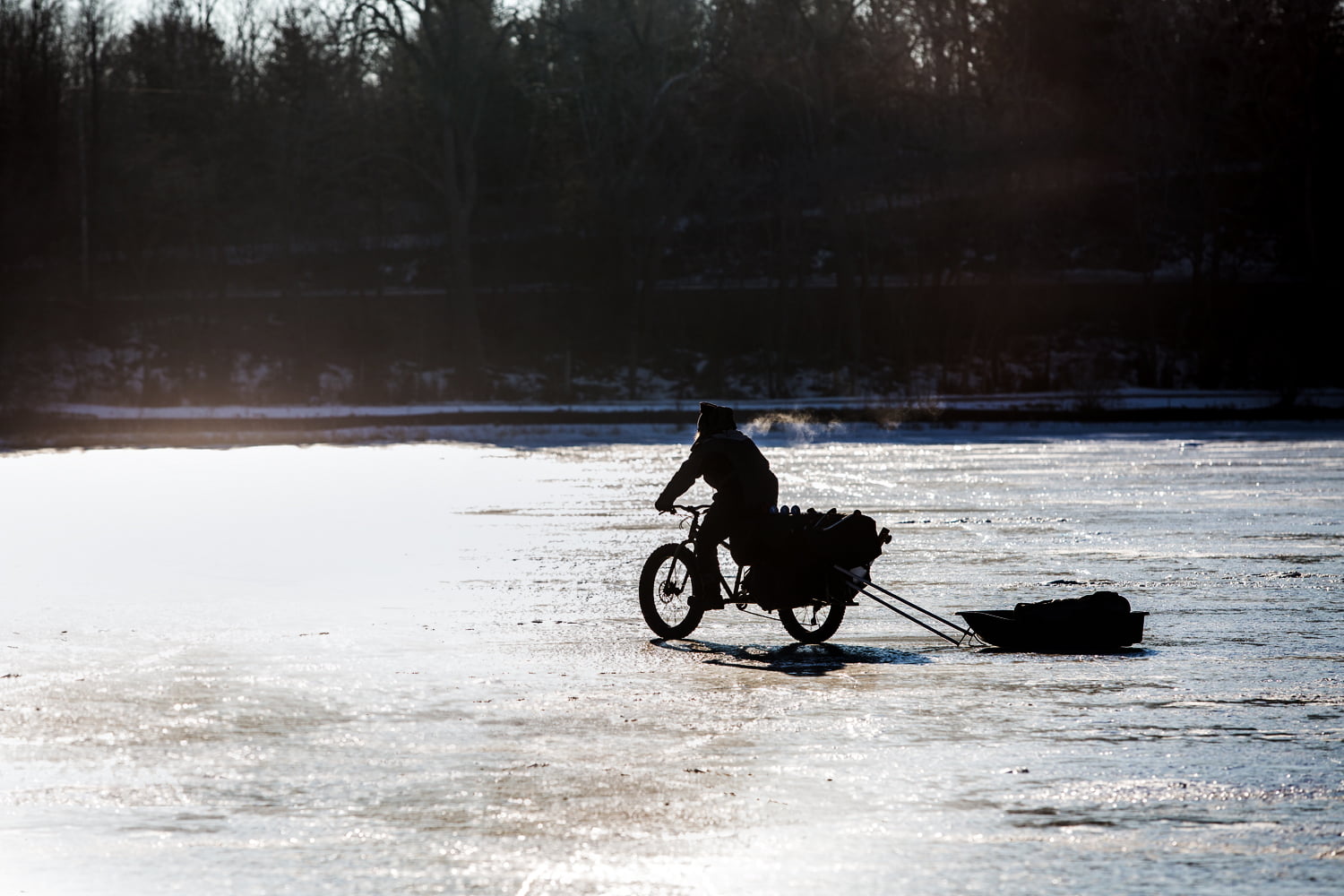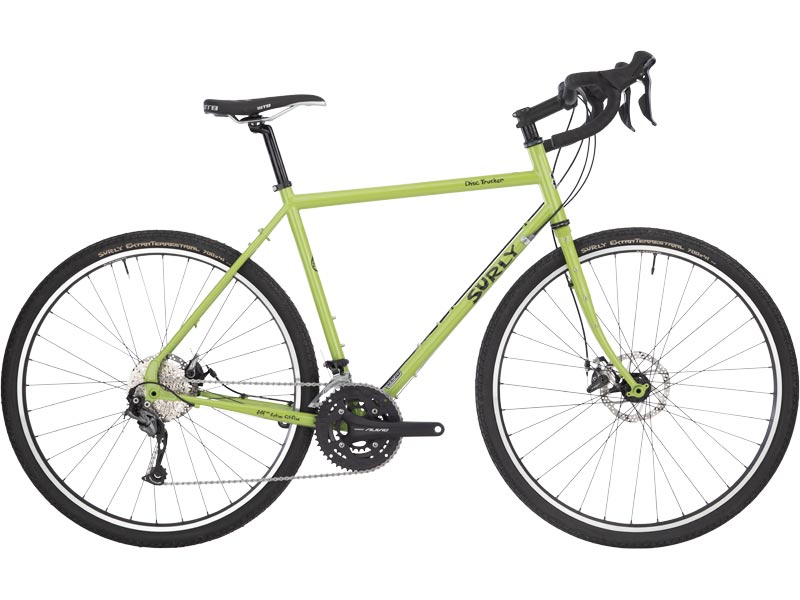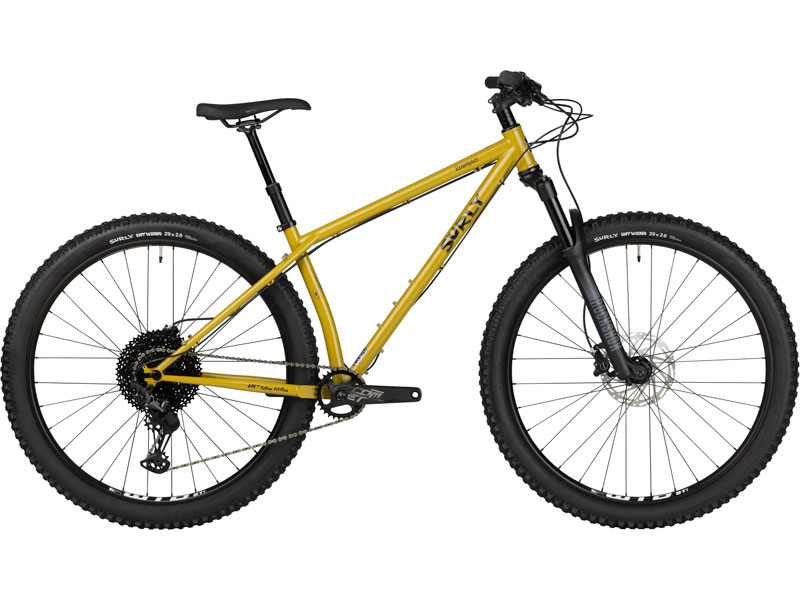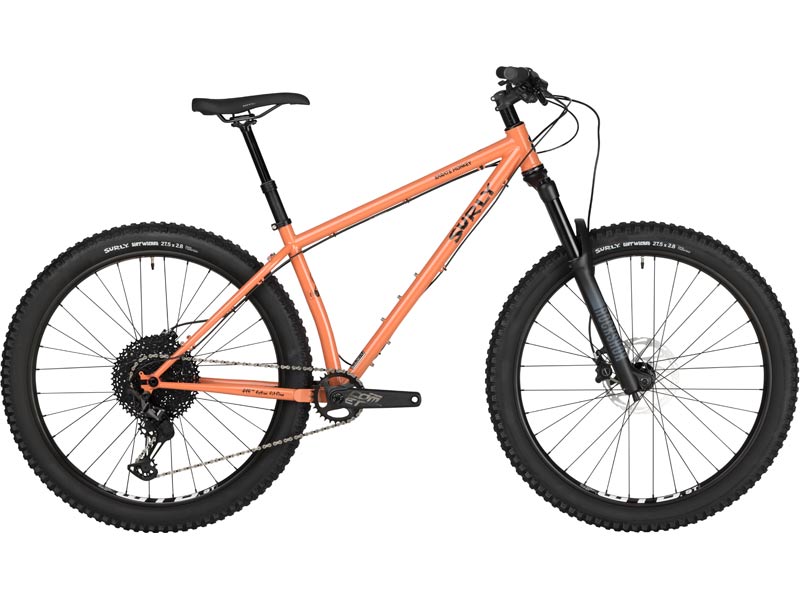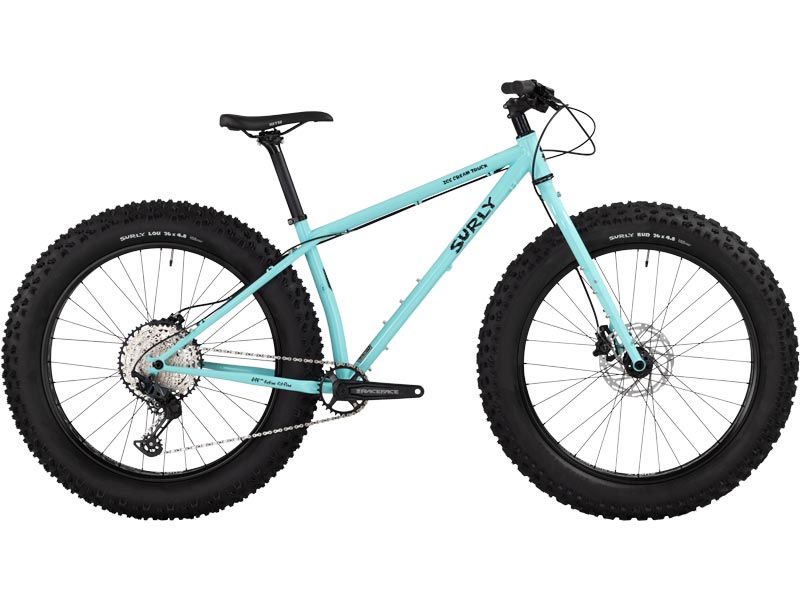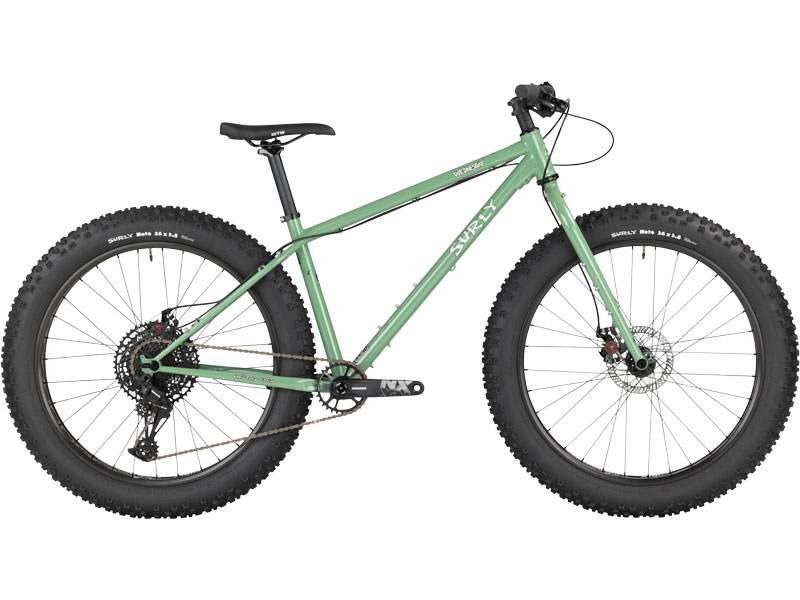
The premise behind Pugsley’s design is the allowance of tires with a larger-than-average
footprint. It was created to go where other bikes may flounder. Our frame and fork will
accept 4" tires on 26" rims. The floatation and traction gained by using largevolume,
low-pressure tires (we highly recommend the Surly Endomorph
3.7 tires) can get you over and through otherwiseunrideable
terrain: ice, snow, sand, mud, wet rocks
and roots. In many conditions, bigger is better.
There are design problems associated with
using wide tires, however: the tire can rub
on the chain, the chainstays, and the front
derailleur. We’ve addressed these issues
by using a 100mm-wide bottom bracket
shell and providing an E-type front
derailleur mount. The 100mm shell
allows us to widen the chainstays for
more tire/frame clearance, and it moves the
chainrings outward for more chain/tire clearance.
An E-type bottom bracket-mounted front derailleur positions the derailleur cage
outboard of the tire. In order to maintain a good chainline with this setup, we offset
the rear hub 17.5mm to the drive side...the same distance that the chainrings moved
outward (compared to the chainline of a bike using a 68mm or 73mm bottom bracket
shell). The result is a straight chainline and the ability to use a standard drivetrain
(compact mountain triple crankset with a full cassette of cogs on a 135mm-spaced hub)
without chain/tire/front derailleur interference. Pugsley has horizontal rear drops
(sometimes called track ends) with a derailleur hanger, so you can set it up as a singlespeed
or internally-geared rig if you don’t want to use derailleurs.
Note: We offer a new offset Large Marge rim extrusion to give you more disc-side dish and
more even spoke tension. Use these offset Large Marge rims on the Pugsley. Non-Surly rims,
intended for use in Pugsley wheels, should be drilled 6-12mm offset to the drive side.
Now, think about trying to shove a 4" (102mm) tire through the dropouts of a fork
designed to accept a standard 100mm-wide front hub. Add a disc brake caliper to narrow
the gap. It all adds up to a big hassle when trying to get a wheel, with an inflated tire,
in and out of the fork. We solved the problem by designing the fork to use a wider hub.
Pugsley uses a 135mm hub on the rear, so it seemed logical to use a 135mm hub on the
front, too. We offset the fork the same distance as the rear end, so the wheels will be
interchangeable. Why would you want interchangeable wheels? If you’re using your rig as
a single-speed, differently-sized freewheels can be installed on each wheel to give you high
and low gear options. You may want a fixed-gear/freewheel option, in case there is a risk
of your freewheel seizing up or not engaging when riding in extreme conditions. A fixed
cog always moves you forward, and it can be used to slow you down if you choose not to
use brakes or if your brakes stop working. If you use the same model of hub front and
rear, you’ll only use 1 or 2 lengths of spokes versus 3 or 4…less confusion and fewer
spare spokes to carry if you’re on a remote tour. If you decide that you don’t want to
use the Pugsley fork, our Instigator fork (as well as many 100mm-travel suspension
forks) has the same axle-to-crown length.
We provide disc brake tabs on the frame and fork. If you’re using discs, you’ll have
to use rear brakes or rear brake adapters on the frame and the fork. Absorb that for
a second: rear hub and rear brake on both ends of the bike. Not everybody needs or wants
disc brakes, so we also provide 120mm-spaced cantilever pivots for those of you who
want to run traditional cantilevers. Keep in mind you’ll need to use our Large Marge rims
to use these types of brakes. The pivots are thread-in type, so they’re removable if you
don’t want ‘em on there. Linear-pull brakes will not work with large-volume tires due
to crossover wire interference.
Who should ride Pugsley? Hunters of all types (animal, mineral, or vegetable), beach/desert
riders, snow/ice riders, wilderness explorers, and anybody else in need of a bike that
will provide extra stability, traction, and floatation when the terrain gets loose and
unpredictable. If you fall into any one of those categories, you should ride a Pugsley.
|
|
SPECS | Pugsley Frameset
|
Tubing: |
100% Surly 4130 CroMoly steel. Main triangle double-butted. TIG-welded
|
Rear dropouts: |
Surly horizontal dropouts with derailleur hanger, 135mm-spaced,
offset 17.5mm
|
Brake compatibility:
|
Most rear International Standard disc brakes (on the frame and fork)
or traditional cantilever-type rim brakes (120mm spaced, for use with Large Marge rims)
|
Braze-ons:
|
Cantilever bosses with removable pivots, dual water bottle mounts, top tube
cable housing guides for use with continuous housing, fender and rack eyelets
|
Seatpost diameter:
|
27.2mm
|
Seatpost clamp diameter:
|
30.0mm, Surly Constrictor included
|
Headset:
|
1-1/8" threadless
|
Front derailleur:
|
E-type
|
Bottom bracket shell:
|
100mm wide, 1.37 x 24t
|
Chainring clearance:
|
Compact triple: 22-32-44t
|
Fork:
|
Suspension-corrected (100mm travel)…447mm axle to crown, tapered straight blade,
4130 CroMoly. International Standard rear disc mount and removable cantilever pivots
spaced 120mm. 135mm-spaced dropouts, 17.5mm offset
|
Color:
|
Metallic Thunderhead Grey
|
Weight:
|
18" = 5.66 lbs (2.57 kg)
Fork - uncut = 2.52 lbs (1.14 kg)
|
|
 |